



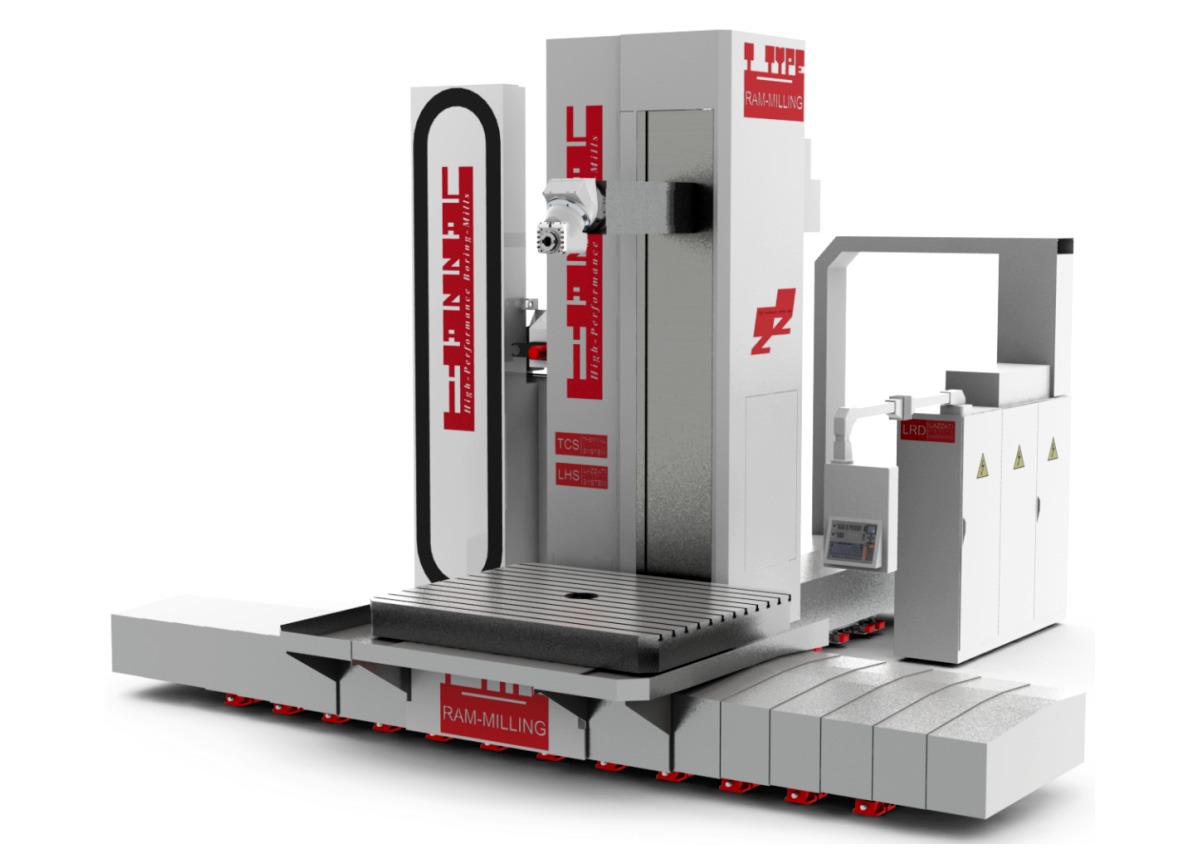
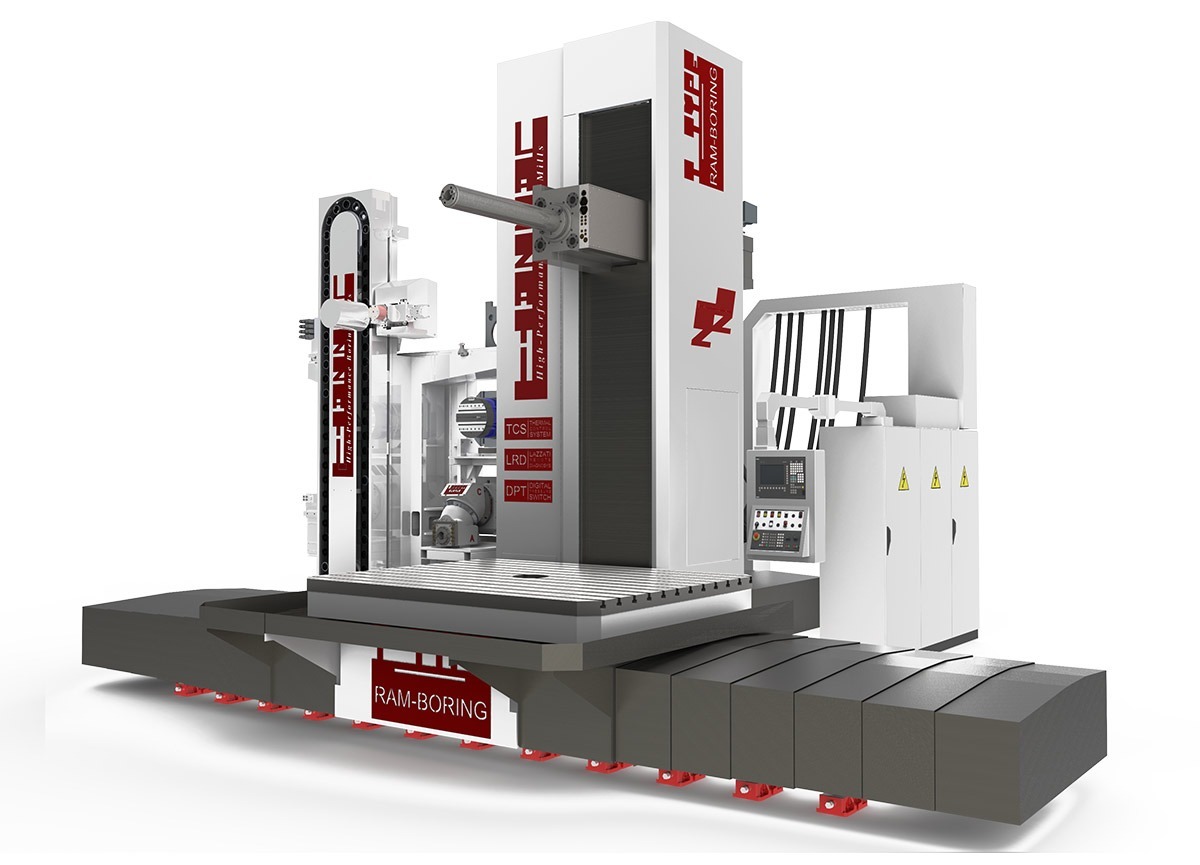
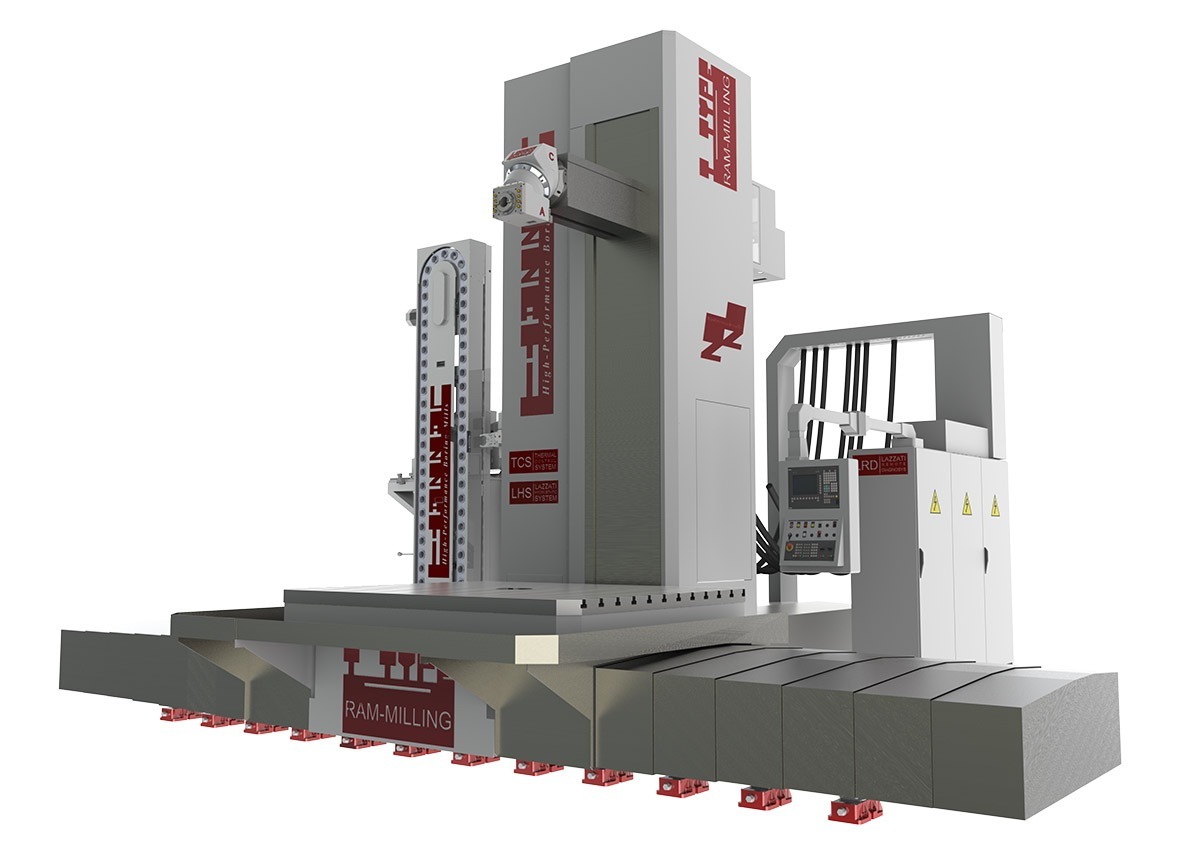




Machine architecture for boring and milling machines determines whether a machine meets its specified performance not only at delivery, but throughout years of production. Machine architecture determines how that performance behaves after thousands of operating hours.
Initial geometric accuracy is essential, but it is only a snapshot taken under defined conditions. Real production introduces cutting forces, moving masses, changing axis positions, thermal gradients, long cycle times and workpieces whose weight may alter the load distribution across the machine. The ability to preserve dimensional consistency therefore depends on more than calibration. It depends on how the complete machine has been engineered to react to mechanical, thermal and dynamic influences throughout its service life.
This is why long-term precision must be evaluated at architectural level. Structural rigidity, hydrostatic guidance, thermal management, compensation logic and control integration are not separate subjects. Together, they define whether a machine remains predictable as operating conditions change. In broader engineering terms, this is the same principle described in the general classification of the horizontal boring machine as an equipment category, where architecture — not a single component — defines long-term capability.
Accuracy Is Proven at Acceptance. Performance Is Proven Over Time.
An acceptance test answers a necessary question: does the machine comply with the agreed geometric and performance criteria at the moment of verification? Measurements of positioning, repeatability, straightness, squareness and machining capability provide an objective reference for both manufacturer and customer. They confirm that the machine begins its operating life from a controlled and documented condition.
Production asks a different question: can the machine preserve that behaviour while loads, temperatures and operating cycles continuously change?
For this reason, acceptance accuracy and lifetime performance should not be treated as equivalent concepts. The first is verified through measurement at a defined moment. The second emerges from the machine’s capacity to retain stable relationships between its structural elements throughout years of operation.
Why Machine Architecture Matters
Machine architecture is the engineering foundation that determines how accurately a machine tool performs not only on the day it leaves the factory, but throughout decades of industrial operation. While acceptance testing confirms compliance with specified performance criteria, long-term precision depends on how the structure behaves under real machining conditions, where mechanical loads, thermal variations and continuous production cycles constantly influence machine behaviour.
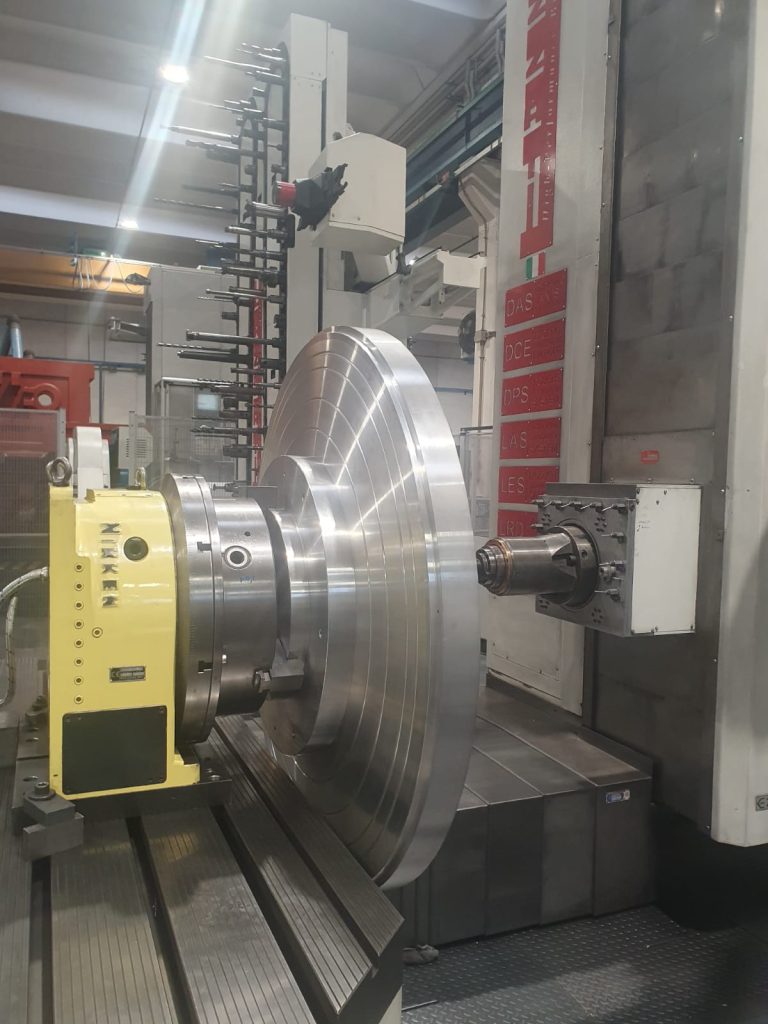
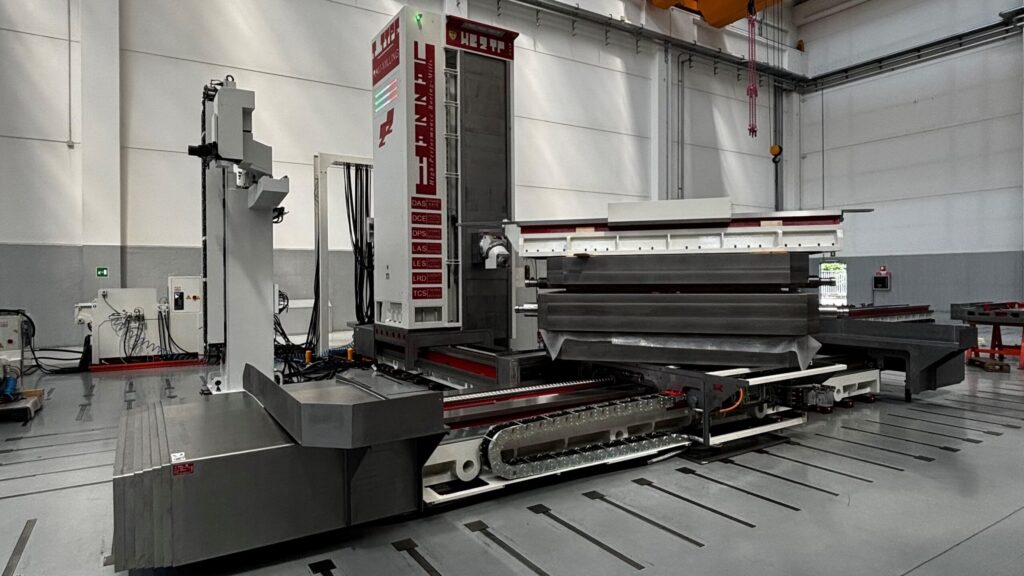
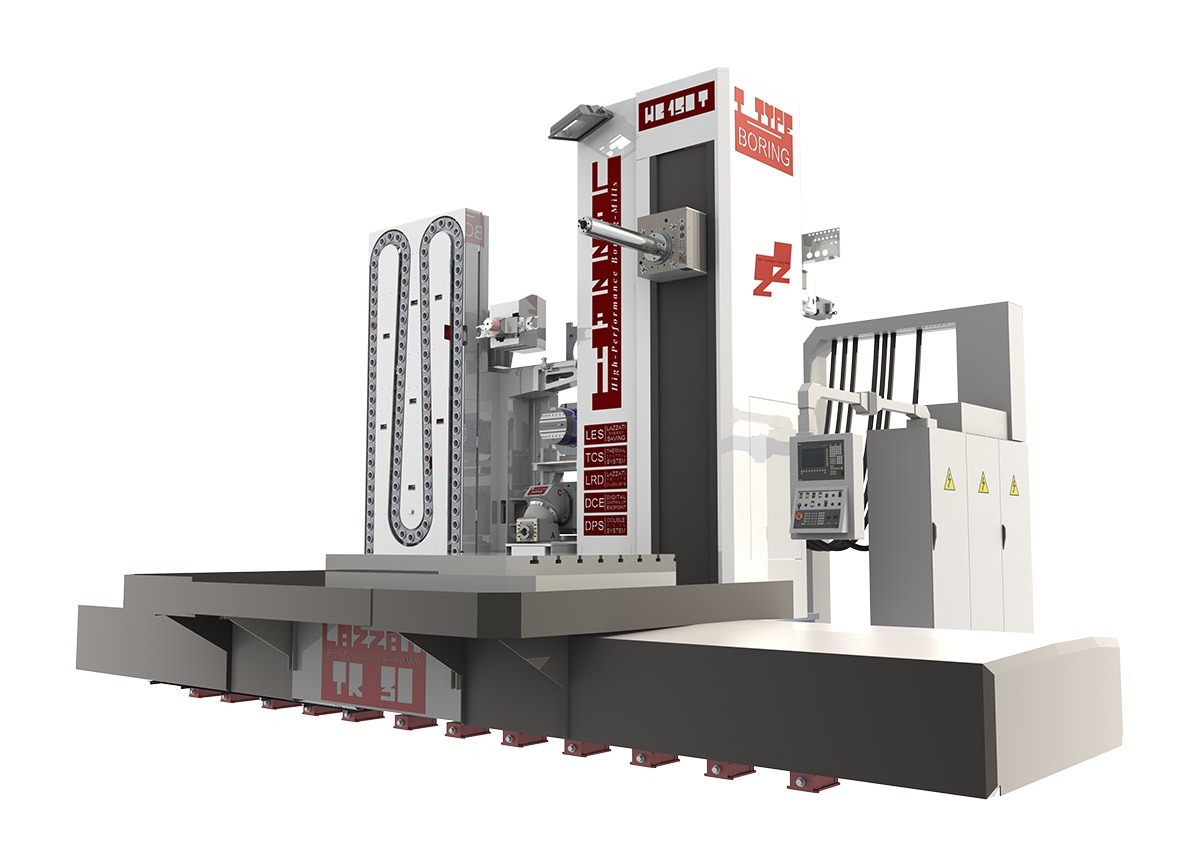
Every structural component — including the bed, column, ram, rotary table and guideway system — contributes to the machine’s ability to maintain geometric stability. Rather than acting as independent elements, these assemblies function as an integrated mechanical system, where stiffness, damping, thermal stability and motion control work together to preserve machining accuracy over the entire operational lifecycle.

This system-level perspective distinguishes long-term engineering from short-term performance. A machine capable of preserving alignment, rigidity and thermal equilibrium under varying production conditions provides stable machining quality, predictable process capability and greater confidence for manufacturers operating in demanding sectors such as energy, aerospace, defence and heavy industry.
Hydrostatic Architecture: More Than a Guideway System
Hydrostatic guidance is often described in terms of low friction or smooth motion. Those benefits are relevant, but they do not fully explain its architectural role in a large boring and milling machine.
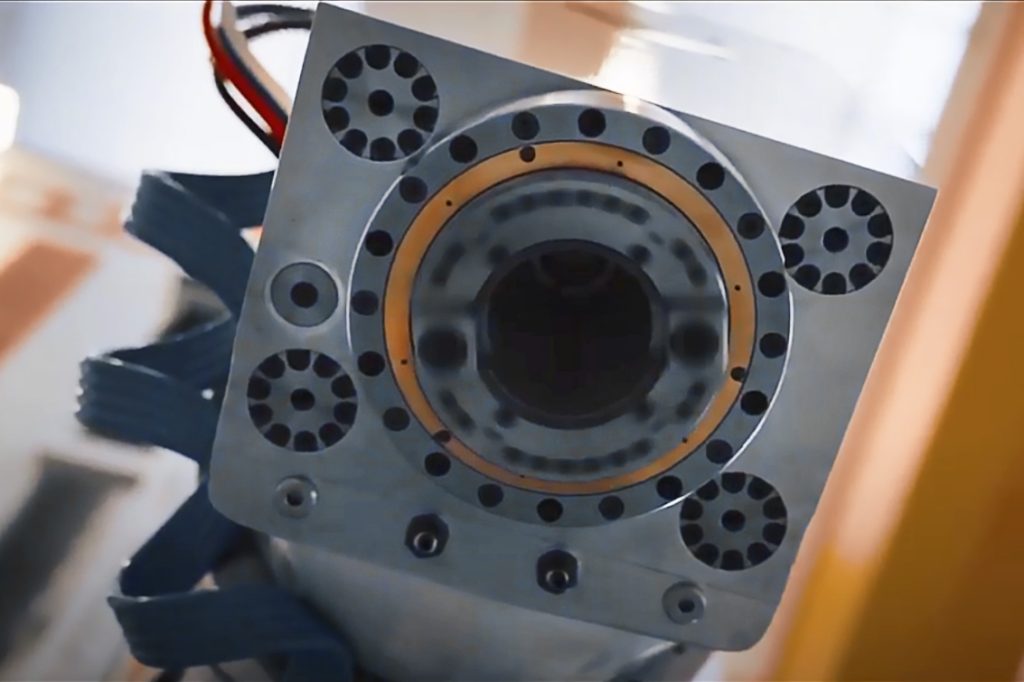
In the LHS – LAZZATI Hydrostatic System, the sliding surfaces are completely separated by a constant oil film of 0.02 mm, generated and maintained through dedicated hydraulic circuits. The absence of metal-to-metal contact eliminates mechanical wear on the guided surfaces and supports consistent motion characteristics over time.
This separation changes the way the guideway should be understood. A conventional contacting guide depends on the condition of surfaces that physically interact. Over extended service, friction, lubrication, local pressure and wear can progressively influence motion behaviour. A strongly preloaded hydrostatic system instead maintains the moving elements on a controlled pressurised film, preserving the relationship between the sliding surfaces without direct contact.
The result is not simply smoother travel. Hydrostatic guidance contributes to stiffness under variable loads, damping of dynamic effects and stable axis movement across the operating range. These characteristics are especially important in machines with large moving masses and extended travels, where the guidance system must support both precision positioning and demanding cutting operations.
In this context, LHS is not an optional accessory added to the machine. It is the standard foundation on which LAZZATI boring and milling machines are engineered. Its role is structural, dynamic and lifecycle-oriented: it supports the preservation of motion quality by removing one of the principal physical mechanisms that can alter guideway behaviour over time — mechanical contact and wear.
An Integrated Engineering Approach
No single technology can independently guarantee long-term machining accuracy. A hydrostatic guideway may preserve its surfaces from wear, but the machine must also manage structural deflection, changing loads, thermal expansion and dynamic conditions. The relevant question is therefore not which system is present, but how the systems work together.
The LAZZATI architecture combines LHS with complementary LAZZATECH systems designed around specific aspects of machine behaviour. The DCS – Dynamic Compensation System supports structural stability. The LAS – LAZZATI Active Stabilization System contributes to the management of changing operating conditions. The TCS – Thermal Control System addresses thermal stability through active temperature management.
The engineering significance lies in their interaction. When a machine changes configuration, the structural load distribution changes. When operating temperatures evolve, dimensional relationships change. When cutting conditions vary, the dynamic response changes. An integrated architecture is designed to manage these influences as parts of the same physical system.
Each system therefore reinforces the others. LHS establishes a wear-free guidance foundation. TCS supports controlled thermal conditions. LAS and DCS address structural and dynamic behaviour. Their combined purpose is not to create an impressive list of features, but to preserve a stable relationship between commanded motion and actual machining conditions.
Engineering Insight
Compensation should not be used as a substitute for sound mechanical architecture. Its highest value is achieved when it works on a machine whose structural, hydrostatic and thermal behaviour is already controlled and repeatable.
Why Thermal Behaviour Cannot Be Separated from Accuracy
Thermal effects are among the most persistent influences on machine-tool geometry. Heat is generated internally by spindle bearings, motors, drives, hydraulic systems and moving axes. It is also introduced externally through ambient temperature changes, workpiece conditions and the machining process itself.
The resulting temperature field is never perfectly uniform. Different parts of the machine warm at different rates and dissipate heat differently. These gradients can alter dimensions, alignment and the relative position of the tool centre point and workpiece.
The TCS – Thermal Control System is therefore part of the machine architecture rather than a secondary utility. By supporting active thermal stabilization, it contributes to consistent operating conditions for the hydrostatic and mechanical systems. The objective is not to eliminate the laws of thermal expansion, but to control the conditions that determine how thermal effects develop and influence machining.
For an engineering team evaluating a machine, this distinction matters. A temperature reading alone says little about dimensional stability. What matters is how temperatures are managed, where they are measured, how the machine structure responds and whether that response remains predictable across the working envelope.
Structural Rigidity Is a System Property
Rigidity is often presented as a characteristic of castings, columns or rams. In practice, the rigidity experienced at the cutting edge is a property of the entire force loop.
Cutting forces travel from the tool through the spindle and ram, into the column and guideways, through the machine foundation and back to the workpiece. Every interface along this path contributes to the resulting displacement. The effective stiffness of the machine therefore depends on the geometry, dimensions, support conditions and interaction of all structural elements.
Hydrostatic guidance contributes by distributing loads over the guided surfaces while maintaining separation through the pressurised oil film. Structural stabilization and dynamic compensation then work within this mechanical foundation to support consistent performance as operating conditions evolve.
The practical implication is clear: catalogue values should be interpreted within the context of the complete architecture. Long-term precision is not defined by the nominal quality of one axis or component. It is defined by how the complete machine behaves when the tool is cutting a real workpiece in a real position under real thermal and dynamic conditions.
When Long-Term Precision Becomes a Competitive Advantage
In high-value manufacturing, dimensional consistency affects far more than inspection results. It influences process planning, setup strategy, tool utilisation, rework exposure and confidence in unattended or extended machining cycles.
In aerospace applications, large structural components may require several operations within one setup. Stable machine behaviour helps preserve the relationship between features machined at different stages of the cycle. In energy and power-generation applications, large casings and rotating components often demand accuracy across substantial dimensions and long cutting times. In oil & gas production, valves, pressure components and drilling equipment combine heavy material removal with critical geometries. Heavy-industry components introduce large masses and variable load conditions throughout the working envelope.
In each case, the machine is not evaluated only by how accurately it can produce one test piece. It is evaluated by whether its behaviour remains dependable across different parts, positions, tools and production periods.
This is where architecture becomes an economic factor. Stable behaviour supports repeatable process planning and reduces the need to continuously rediscover how the machine reacts under changing conditions. The value is not based on an abstract claim of accuracy, but on the machine’s capacity to provide a consistent engineering platform for production.
For capital equipment expected to operate for decades, this distinction is decisive. Initial performance determines whether the machine can enter production. Long-term precision determines how confidently it can remain productive throughout its lifecycle.
Engineering for Lifetime Performance
A machine tool should not be assessed as a collection of specifications frozen at the date of delivery. It should be assessed as a physical system that will experience millions of axis movements, changing temperatures, variable loads and repeated machining cycles.
From this perspective, the most relevant design decisions are those that protect consistency. Wear-free hydrostatic guidance preserves the condition of the sliding interfaces. Thermal control supports predictable temperature behaviour. Structural stabilization and dynamic compensation respond to changing configurations and loads. Digital monitoring and control technologies connect these physical systems to the operating environment.
The objective is not to claim that a machine is unaffected by physics. It is to engineer the machine so that physical effects are controlled, measurable and repeatable. Every parameter must be verifiable, and every technology must contribute to a defined function within the architecture.
This is also why machine selection should extend beyond a comparison of acceptance values. Two machines may demonstrate similar results during a controlled test while relying on fundamentally different engineering principles to maintain those results over time. Understanding the architecture reveals how each machine manages wear, load, heat and motion after the acceptance test has been completed.
For manufacturers investing in a new boring and milling machine, the decisive question is therefore not only, “What accuracy can this machine demonstrate today?” It is also, “What engineering principles are in place to preserve that behaviour throughout its service life?”
That is the point at which machine architecture becomes an investment criterion. It connects technical design to operational continuity and makes long-term precision a consequence of engineering rather than expectation.
Key Takeaways
- Acceptance testing verifies machine performance under defined conditions; architecture determines how that performance behaves over time.
- Long-term precision depends on controlled and repeatable responses to load, motion, temperature and dynamic forces.
- LHS uses a constant 0.02 mm oil film to separate the sliding surfaces, eliminating metal-to-metal contact and mechanical wear on the hydrostatic guideways.
- Hydrostatic guidance, thermal control, active stabilization and dynamic compensation must be considered as an integrated engineering system.
- Compensation is most effective when the underlying mechanical and thermal behaviour is already stable and predictable.
- Machine architecture provides a more complete basis for investment evaluation than acceptance values considered in isolation.
Frequently Asked Questions
What is machine architecture in a boring and milling machine?
Machine architecture is the engineering framework that defines how the structure, guideways, spindle, axes, thermal systems and control technologies interact. It determines how forces, heat and motion are managed throughout the working envelope and over the machine’s operating life.
Why does acceptance accuracy not guarantee long-term precision?
An acceptance test confirms performance at a specific time and under controlled conditions. Long-term precision also depends on how the machine reacts to wear, thermal gradients, changing loads, axis configurations and repeated production cycles.
What is the role of hydrostatic guideways?
Hydrostatic guideways maintain separation between sliding surfaces through a pressurised oil film. In the LAZZATI LHS system, the constant 0.02 mm oil film eliminates metal-to-metal contact, supports stiffness under variable loads and preserves the condition of the guided surfaces over time.
How does thermal control support machining accuracy?
Thermal control helps manage the temperature conditions that influence machine geometry. By stabilizing relevant systems and limiting uncontrolled temperature variation, it supports predictable dimensional behaviour during extended machining operations.
Why are LAS, DCS and TCS evaluated together with LHS?
Each system addresses a different aspect of machine behaviour. LHS provides the hydrostatic guidance foundation, while LAS, DCS and TCS support structural, dynamic and thermal stability. Their value is greatest when they operate as parts of one integrated architecture.
What should manufacturers compare beyond acceptance-test results?
Manufacturers should compare how each machine manages guideway wear, load distribution, ram extension, thermal variation, dynamic response and compensation. These principles provide insight into how the machine is engineered to preserve performance after commissioning.
Discover More
Machine architecture determines how precision is preserved beyond commissioning. Explore how LAZZATI integrates hydrostatic guidance, structural stabilization, thermal control and dynamic compensation in CNC boring and milling machines engineered for long-term accuracy retention.
Request a Technical Consultation to discuss your machining requirements, workpiece dimensions and operating conditions with our engineering team.
Related Technologies
- LHS – Hydrostatic System
- LAS – Active Stabilization System
- DCS – Dynamic Compensation System
- TCS – Thermal Control System